Multimessenger astrophysics refers to the coordinated use of electromagnetic radiation, particles, and other carriers to characterise the behaviour of relativistic systems. At the theoretical level, this approach relies on a tightly interwoven framework: cosmic rays, neutrinos, and gamma rays are physically linked through common acceleration and interaction sites, while gravitational waves provide a dynamical probe of the same extreme environments. Nature seldom produces mono-energetic particle beams; broad-band primaries inevitably generate broad-band secondaries, and thus naturally yield multi-frequency emission. Charged particles rarely radiate through a single mechanism, and distinct processes emit at different characteristic energies. Whereas thermal emission tends to occupy relatively narrow spectral intervals, particles energetic enough to produce gamma rays typically radiate efficiently at many lower frequencies as well. In addition, particle interactions and decays give rise to entirely new messengers, widening the accessible information channels. Because the fluxes of different secondaries are ultimately comparable—hadronic interactions, for example, distribute energy among mesons of various charges that decay into photons, electrons, neutrinos, and other products—instruments of similar sensitivity can collectively reconstruct a detailed picture of the internal workings of the astrophysical systems under study.
Gravitational waves have become a central element of this landscape. Their direct detection has opened an independent window on compact-object dynamics, capable of tracing mass flows, merger energetics, and strong-field gravity in ways inaccessible to photons or particles. Crucially, multimessenger follow-up of gravitational-wave events, with rapid and coordinated observations across all wavebands and particle channels, has enabled the determination of physical properties such as ejecta composition, jet structure, and nucleosynthesis yields. These developments have made clear that, in an ideal sense, all astrophysics is or ought to be multimessenger astrophysics: only by combining photons, particles, and gravitational waves can we approach a complete description of the most energetic phenomena in the universe.
Main courses and topics will include
· Unit 1: Radiation processes and basic processes
A. Patruno (ICE-CSIC)
Acceleration processes, radiation by an accelerated charge, high energy astrophysical radiation, synchrotron, inverse Compton, curvature and synchro-curvature processes, hadronic interactions.
· Unit 2: Cosmic ray astrophysics:
S. Gabici (APC)
Generation and measurement of the cosmic ray spectrum, ultra-high energy cosmic rays, propagation, diffusion, absorption, Galactic cosmic rays, Extragalactic cosmic rays and the GZK cutoff, cosmic rays and star-formation regions. Cosmic ray experiments from ground and space
· Unit 3: Gamma-ray astrophysics:
D. Hadasch (ICE-CSIC)
Gamma-ray background. Issues at different energies from MeV to GeV and the kind of detectors needed for each. Gamma-ray populations. Difference in reach and techniques in GeV and TeV astronomy.
· Unit 4: Neutrino astrophysics:
A. Franckowiak (Bochum)
Basics of neutrino physics. Neutrino oscillations. Propagation effects. Measurements techniques. Solar and astrophysical neutrinos, difference in physics, detection methods, and energies. Experiments on ice and water.
· Unit 5: Gravitational wave astrophysics:
S. Husa (ICE-CSIC)
Basic theoretical background. Wave propagation and emission, basic physics of compact objects as sources of gravitational waves. Interferometric experiments from ground and space. Matched filtering vs. waveform agnostic data analysis methods. Waveform phenomenology and modelling. Extracting astrophysical parameters.
Special courses and hands-on will include
· Statistics for astrophysics [3 hours]: J. Sitarek (LLodz U.)
· Hands-on Fermi Data [3 hours]: G. Martí-Devesa + Z. Zhao + O. F. Coban (ICE-CSIC)
· Hands-on gammapy with applications to TeV astronomy [3 hours]: R. López Coto (IAA-CSIC) + E. Mestre (ICE-CSIC)
· Machine learning for multi-messenger astrophysics [5 hours]: J. Gomblitza (FAU)
· Multiwalength Transients [3 hours]: F. Coti-Zelati (ICE-CSIC)
· Hands-on LIGO/VIRGO data [3 hours]: H. Estellés (ICE-CSIC)
· Handling transients among instruments [1 hour]: H. Ashkar (ICE-CSIC)
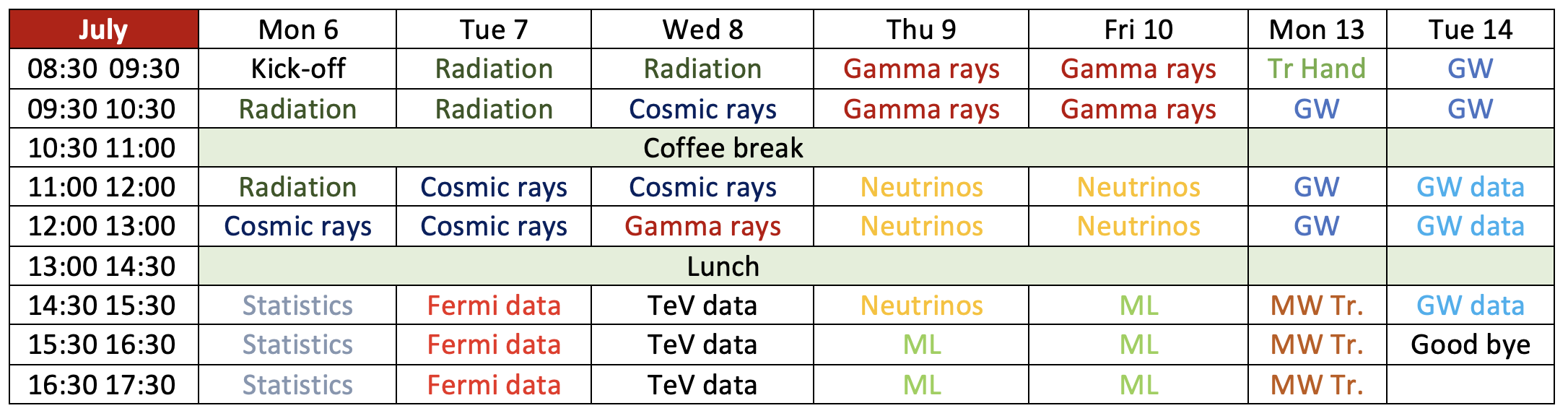
Schedule
Organizing research groups at ICE-CSIC
GW: Gravitational Waves Group
MAP: Multimessenger Astrophysics Group
Organizer Team
D. Hadasch
S. Husa
A. Patruno
D. F. Torres (chair)
Multimessenger astrophysics at the institute of Space Sciences (ICE-CSIC)
The “Multimessenger astrophysics group”, MAP, focusing on cosmic rays, relativistic environments, and compact objects was found at ICE-CSIC in 2006 and it had and has significant involvement in the NASA satellite Fermi, the ground-based array MAGIC, the Large Size Telescope (LST), and the Cherenkov Telescope Array, besides others at lower frequencies. MAP research highlights go from advanced theoretical modelling of compact objects and cosmic ray sources, to discovery and characterization of acceleration sites, including the first supernova remnants or starbursts seen in gamma-rays. Current work of the MAP group involves modelling of pulsar light curves and spectra as well as of their and pulsar wind nebulae, gamma-ray binaries and microquasars and introducing advanced mathematical tools into high energy astrophysics.
Also at ICE-CSIC, the gravitational waves effort is solid both from the experimental and theoretical side, having had a relevant participation in the experimental setup for the very successful LISA Pathfinder, in the current preparation of LISA, and now also in the exploitation of LIGO/VIRGO and the future ET. The focus of current theoretical work of the gravitational waves group is on modelling and Bayesian parameter estimation targeted at compact binary coalescence from stellar objects to supermassive black holes.
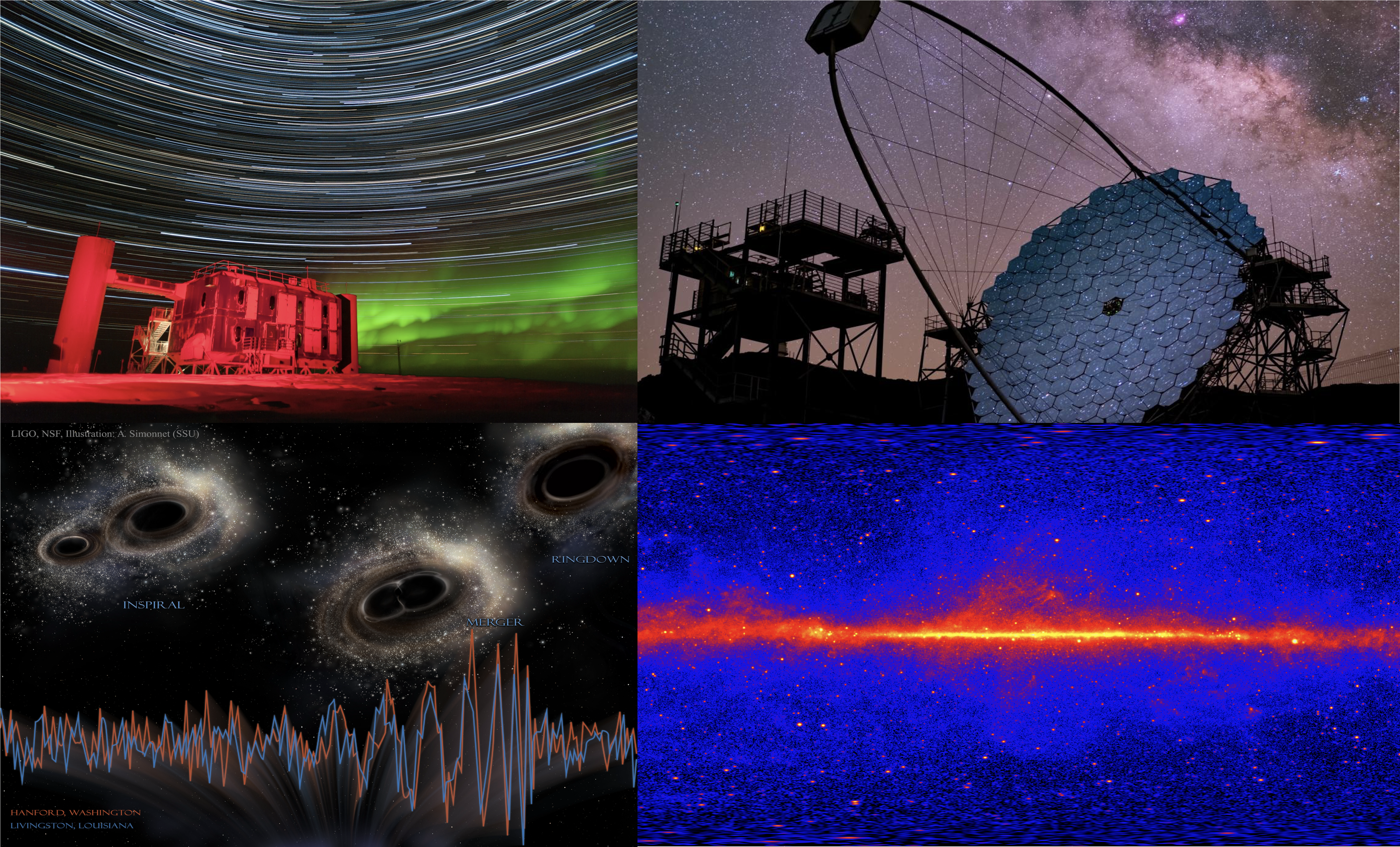
Images in this page: The LST-1 telescope at the Roque de los Muchachos Observatory (Garafía, La Palma). Credit: Daniel López / IAC; The ICECUBE GALLERY detector, The IceCube Collaboration; Illustration of the first gravitational wave event observed by LIGO, Aurore Simmonet (Sonoma State University); Fermi-LAT NASA Gallery.