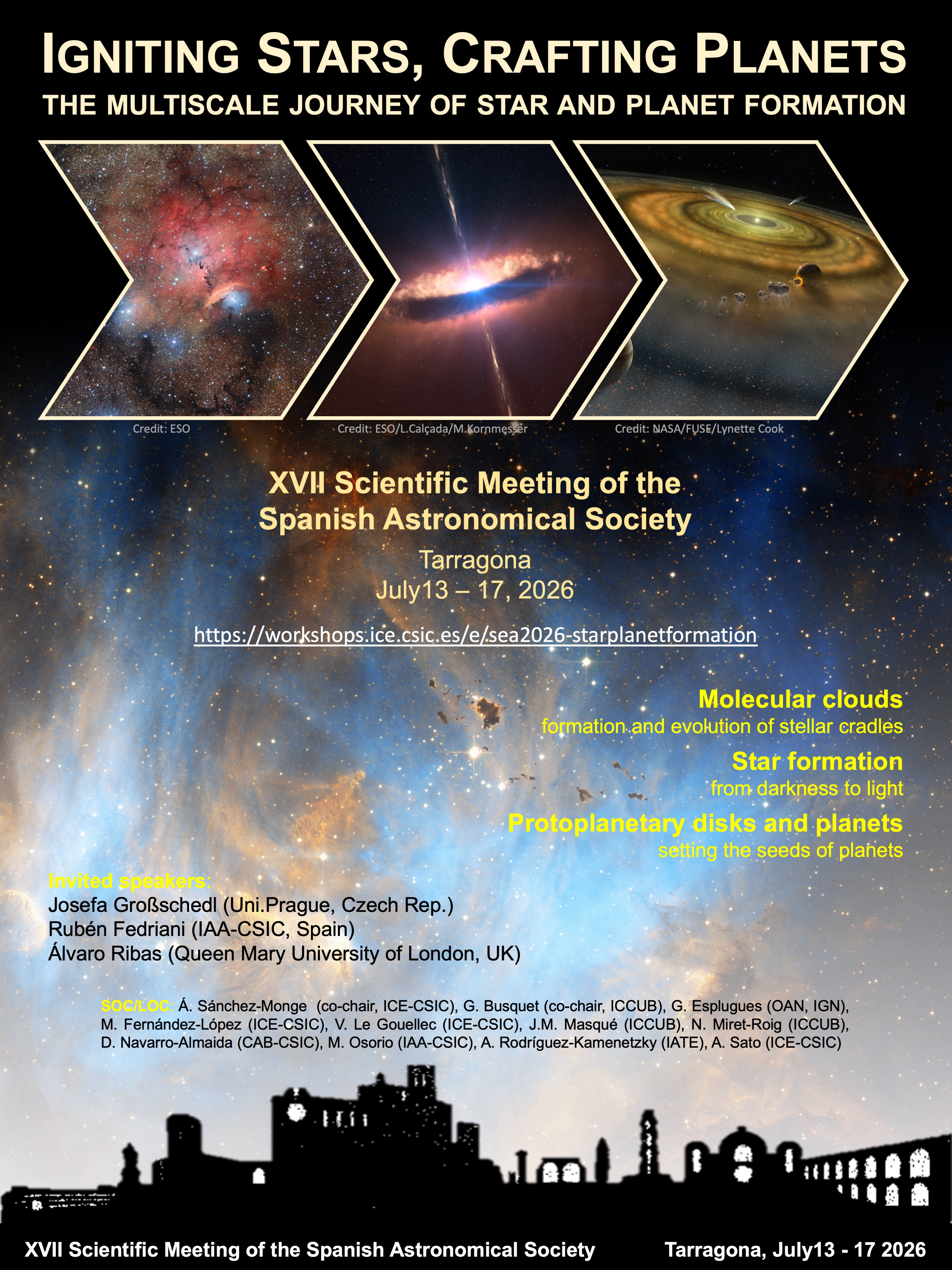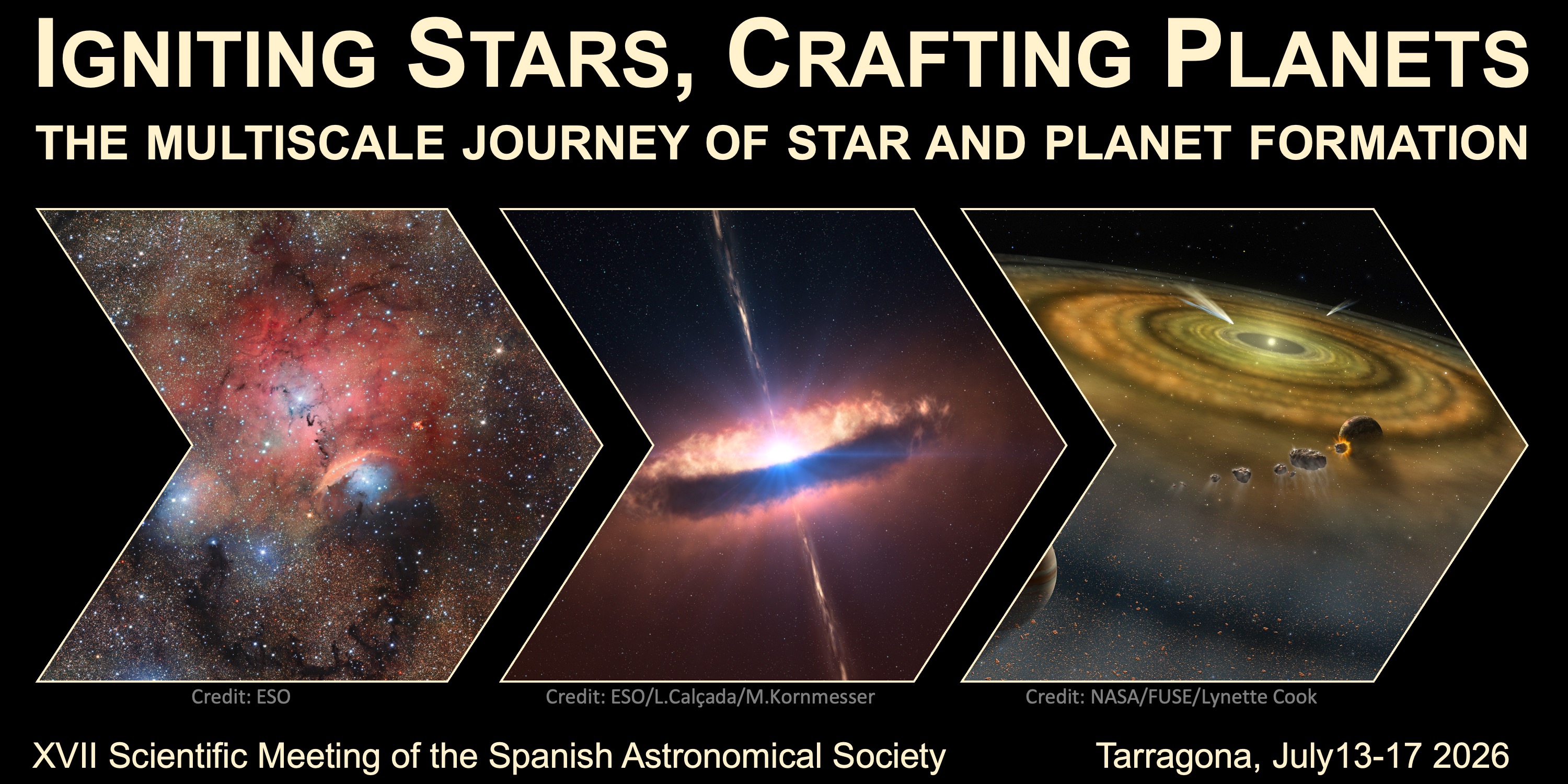
Igniting stars, crafting planets:
The multiscale journey of star and planet formation
From the molecular cloud collapse to the emergence of habitable worlds, star and planet formation are among the most fundamental processes shaping our Universe. Understanding how stars ignite, how planetary systems assemble around them, and why such systems display an astonishing diversity remains a big challenge in astronomy.
The multifaceted and multiscale nature of star and planet formation renders it a complex scientific venture. Stars are born within dense, dusty regions of molecular clouds, where gravity competes with turbulence, magnetic fields, radiation and feedback from nearby young stars. These environments are opaque at visible wavelengths, making the earliest phases of star formation notoriously difficult to observe. As a star grows, it is surrounded by a rotating disk of gas and dust - the birthplace of planets. Within these protoplanetary disks, microscopic grains collide and stick, eventually forming planets. How this growth proceeds efficiently, how disks evolve and disperse, and how planetary architectures are sculpted by migration, chemistry and stellar radiation are still open questions.
Nevertheless, in recent years, the field has undergone a revolution thanks to high-resolution observations from telescopes such as ALMA and JWST, which have revelaed intricate disk substructures - rings, gaps, spirals and asymmetries - hinting at ongoing planet formation at the same time as the star formation occurs. At this regard, advances in numerical simulations also allow us to connect small-scale physical processes with the large-scale environment evolution of star-forming regions delivering a complete and more nuanced picture of how stars and planets come to be.
This symposium aims to bring together researchers in the star and planet formation fields to discuss the latest observational and theoretical progress. Building on the success of the previous symposium “On the Origin of stars and their planets: A holistic view” held in 2024 during the XVII SEA scientific meeting, this symposium aims to promote and strenghten collaborations and synergies between different communities aiming to understand the origin of stars and planets.